Hand of hope… or just a (primitive) reflex?
September 14, 2013
In 1999 a report was published about a boy (Samuel Armas) that grasped his surgeon’s hand from a hole in his mother’s uterus during open fetal surgery for spina bifida.
The story became an internet hit and in september 2011 the story became hyped again due to a controversy because it was used by opponents of abortion who asserted that the baby reached through the womb and grabbed the doctor’s hand, thus showing signs of life at the 21st week of pregnancy.
A hand of hope… or just a (primitive) reflex?
Doctors have reported that it is not unusual for babies in this position to reach out to the world, and during a spina bifida surgery both the mother and the fetus are under anesthesia – which implicates that both can not move.
The truth is that any grasping ‘hand of hope’ in likewise conditions can best be described as nothing but a simple primitive reflex (a.k.a. a palmar reflex), which are automatic reflex actions of the body originating in the central nervous system. This implicates that such apparent ‘reflexes’ should not get confused with conscious behavior.
What you might want to know about:
Primitive reflexes of the hand!

Hand gestures grew out of fish brains!
August 24, 2013

This summer an important fundamental discovery was reported at the Society for Experimental Biology’s annual meeting July 3-6 in Valencia, Spain: hand gestures grew out of fish brains!
Andrew Bass, Cornell professor of neurobiology and behavior, described how he found evidence that illustrates how fish are able to vocalize and communicate via their pectorial fins:
“Using methods to understand how the brain is connected to different muscle groups, we mapped the early development of two systems in the brain that control muscles that allow fish to vocalize and to move their pectoral fins.”
“Using methods to understand how the brain is connected to different muscle groups, we mapped the early development of two systems in the brain that control muscles that allow fish to vocalize and to move their pectoral fins. We found that these systems arise from the same compartment.”
“Evidence that the evolutionary origins of the link between speech and gesturing can be traced to a developmental compartment in the caudal hindbrain of fish.”
This insight can be understood visually by notifying how the pectorial fins in fishes are usually located close to the hind brain – see picture below.
Source: 11 strange things we learned this summer

Do you have a radial loop fingerprint?
August 5, 2013
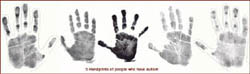
 Do you have a radial loop fingerprint? In people who have radial loop fingerprints these are usually spotted on the index finger(s); in the field of hand reading it is a common beliew to associate radial loops with ‘people who do not go with the flow’ – refering to the fact that the radial loop represents sort of the opposite of the much more common ulnar loops. But what are the facts and how do they develop?
The latest research points out that a radial loops might have a connection with the Big Five personality dimension Extraverion (see picture below).
This article presents 10 facts about radial loops:
http://www.handresearch.com/news/10-facts-about-radial-loop-fingerprints.htm

 In 2010 the United Nations declared 18 July as ‘Mandela day’ (or: Nelson Mandela International Day), an annual international day in honour of Nelson Mandela. Mandela Day (which is also Madiba’s birthday) is a global call to action that celebrates the idea that each individual has the power to transform the world, the ability to make an impact. Mandela’s hand prints included in his ‘My Robben Island’ art project has been adopted since then as an icon-symbol refering to Mandela Day.
Earlier this week South-Africa president Zuma has called for July 18 2013 to become the ‘biggest Mandela Day ever’!
SOURCE (= A tribute to Nelson Mandela’s hands):
http://www.handresearch.com/thumbs/hands-nelson-mandela-thumbs-handprint.htm

 The human opposable thumb: with reason neurologist Frank R. Wilson called it ‘the Twenty-Four-Karat thumb’. Because thumb studies in primates have revealed that only humans have ‘perfect opposable thumbs’. But there is more, because new evidence indicates that the opposable thumb has a direct correlation with self-awareness in the primate family!
Scientists say that there are two things that have given rise to man’s dominance as a species: one is the opposable thumb, the other is self-awareness. Interestingly, scientists also developed a test to assess ‘self-recognition’ (which is in psychology known as a first milestone in the development of self-awareness in young children) via the so-called ‘mirror test’.
The video below shows how this ‘mirror test’ has also been used to assess the capability for self-recognition in primates. And the table below displays a strong correlation between self-recognition and the opposable thumb in the primate family tree (+ a the bottom a picture is presented summarizing the hand characteristics seen in the listed primate species).
SOURCE: Opposable thumbs & self-awareness!


Interactive chart: discover hand reflexology!
April 1, 2013
 Discover how areas of the hands are approximate to the body’s anatomy with the interactive hand reflexology map widget developed by Barbara Kunz & Kevin Kunz, two of the world’s most internationally respected and experienced reflexologists:
http://www.reflexology-news.com/reflexology/reflexology-hand-chart.htm
NOTICE: More about the work of the Kunz-family at:
www.reflexology-research.com
The primate hands family tree shows how dominant behavior in primates can be linked with hand structure. For example, gorillas & baboons are known to belong to the most dominant/aggressive primate species and both species have a hand structure that is different from other primate species!
It is rather fascinating to see that both species (gorilla + baboon) actually have a hand structure that reminds us of the typical hand differences seen between males and females, incuding: short fingers, broad palms & a low 2D:4D digit ratio.
These biological & evolutionary patterns appear to explain why in nearly all primate species males tend to dominate females. Except for the bonobos of course, females tend to collectively dominate males by forming alliances and use sexuality to control males – interestingly, a few years ago a study reported that bonobos have a rather human-like 2D:4D digit ratio (close to 0.94)… which is illustrative for their rather high emotional intelligence. The Bonobo-society has been described as ‘extraordinarily peacefull’.
This illustrates that Sir Charles Bell was very right about the hand representing capacity, and modern science has still a long way to go in order to understand properly how the structure of the hand corresponds with behavior!
More details:
http://www.handresearch.com/news/primatology-palm-reading-primate-hands-family-tree.htm
The fate of a violin player resides in their pinky finger!
February 11, 2013

Nina Lordi – Professional violinist.
The violin is known as the instrument most commonly offered to children by state schools in the UK. It’s a challenging instrument, because rapid independent motion of the digital joints in the left hand is desirable… and a requirement in order to become a top violin player! A brand new study focussed on the pinky finger was designed after an 11-year-old patient volunteered that she had given up playing the violin because of difficulty and discomfort manoeuvring the left small and ring fingers independently. On examination, she was found to have absent FDS (flexor digitorum superficialis) function in the small finger – a condition that can be found in about 6% of the general populaton.
Do you have the ‘flexor digitorum superficialis’?
You can test this right now at home (see also the video below): hold down the index, middle, and ring fingers of your left hand, then try to bend your little finger. Now try it again, but allow your ring finger to bend as well.
Can you do it?
The UK study revealed that about 18 percent of people can do neither!
However, in a group of 90 professional musicians from “three of London’s leading orchestras” (38 first violinists, 33 second violinists, 19 viola players), none lacked this ability, and all but two were able to bend just their pinky finger!!!
Via: The Atlantic
The Megan Fox thumbs ‘saga’ continues!
February 9, 2013
 Last december the Megan Fox thumb ‘saga’ continued at The Tonigh Show with Jay Leno, where Megan talked about her thumb insecurities (she has clubbed thumbs)… suggesting that she thinks her weird ‘fat’ thumbs are the result of her mom eating Tuna during her pregnancy of Megan!
Megan described:
‘What is weird to me is I was talking to my mom … and she was like, “Oh, I ate tuna every day when I was pregnant with you,” I was wondering if that was what happened to my thumbs. They’re weird and they’re really fat and there’s like a weird knuckle.’
Now that Megan has become a mom herself (in the summer of 2012 Megan wondered if she was maybe birthing a vampire baby like the one from ‘Twilight’), it is heartbreaking to see that she now has the guts to talk about her thumb insecurities. Hopefully, this will inspire other people having this physical anomaly to deal with feeling of shame!
TIP – Megan Fox thumb tribute!
(The episode was featured at VH1 & below you can find the YouTube video featuring Megan Fox interview in december 2012 at The Tonight Show with Jay Leno)
Earlier reports about Megan Fox’ toe tumbs:
• Actress Megan Fox has the clubbed thumb (BDD) – it’s a hereditary cosmetic defect! (2009)
• Megan Fox’ stubby thumbs replaced for Motorola Super Bowl commercial! (2010)
• Megan Fox has Obsessive Compulsive Disorder: what are the associated hand characteristics? (2010)
• Megan Fox’ thumb got Photoshopped in Armani Jeans & Underwear Campaign! (2011)
 Iran’s new finger-chopping machine may be touted as a punishment for thieves, but Mahmoud Amiry-Moghaddam (spokesperson for Iran Human Rights in Norway) thinks this cruel and unusual method of punishment is really just an attempt to crush political dissent!
Iran has unveiled its latest innovation in criminal punishment – a machine that cuts off the fingers of thieves. A series of photographs appearing to show a blindfolded man having his fingers severed by the mechanical amputation device, have been published latelly by an official Iranian press agency.
According to the INSA news service, the prisoner used to demonstrate the brutal contraption had been convicted of theft and adultery by a court in Shiraz last Wednesday. The series of pictures show three masked officials, clad entirely in black, holding the man’s right hand in a vice while one turns a wheel operating the guillotine in the manner of a rotary saw.
This warning, issued without explanation, is perceived by various authorities to deter public protest ahead of June’s general elections.
More impression from the published series of photographs is available at The Telegraph
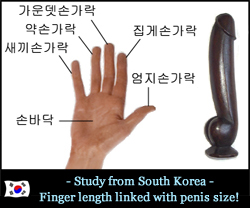 Finger length & penis size linked!
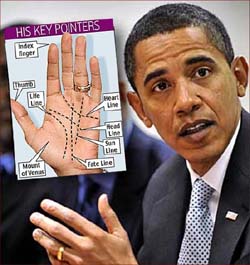 The hands of Barack Obama
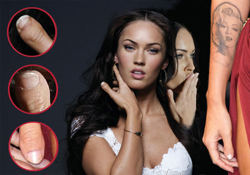 Megan Fox thumbs – TRIBUTE
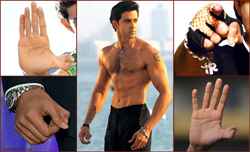 Hrithik Roshan thumbs – TRIBUTE
 Hand Reading Research!
 MultiPerspective Palm Reading


 Hand Facts: News about hands!